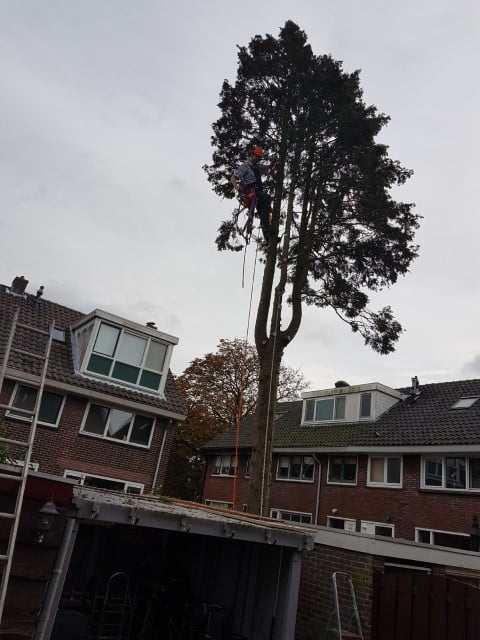
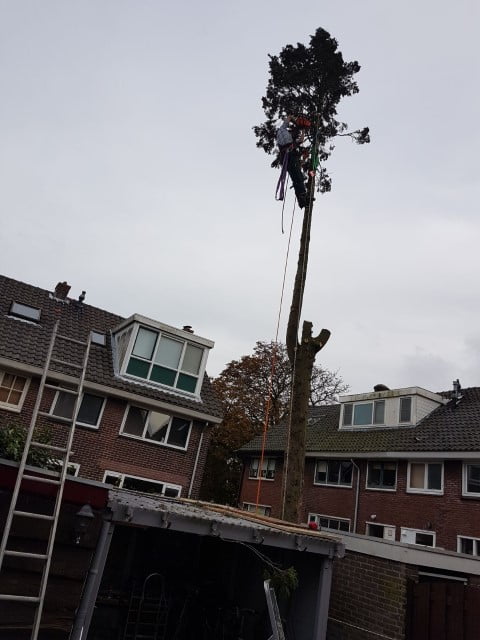
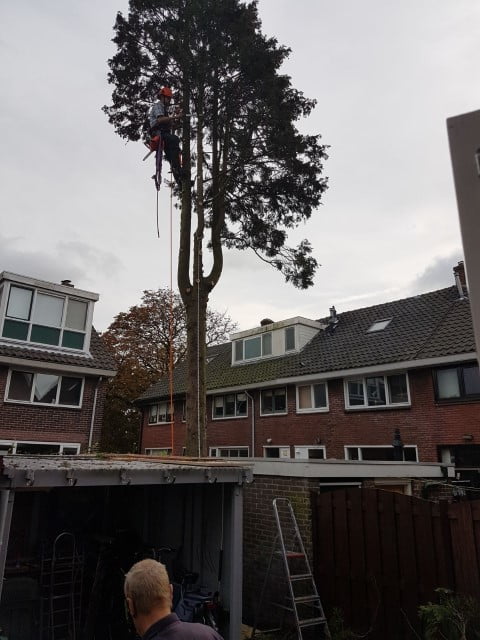
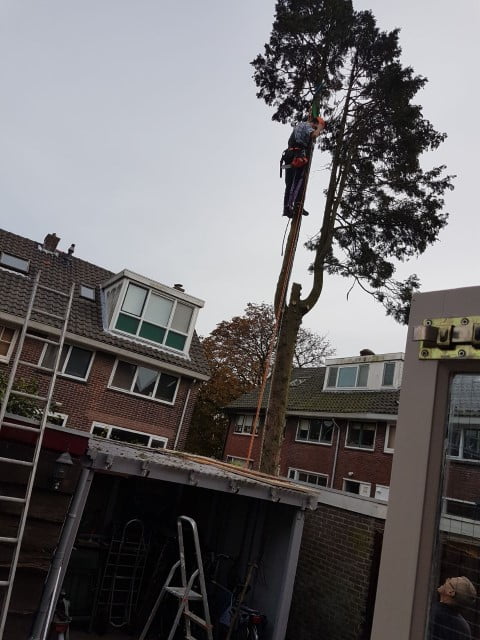
A special tree. A 50 year old conifer, with many dead branches, in a much too small spot of about one meter wide between two sheds and with the back against (!) a shed. The dead branches may be caused by the limited water supply and nutrients under the sheds. That is why this place was no longer suitable for this tree. This conifer had already been topped. This has created three different, competing summits. Topping too low is therefore never a solution to reduce the height of a tree. It works temporarily, but the result will be that multiple peaks will arise, which will (literally) only make the problem worse in the long term.
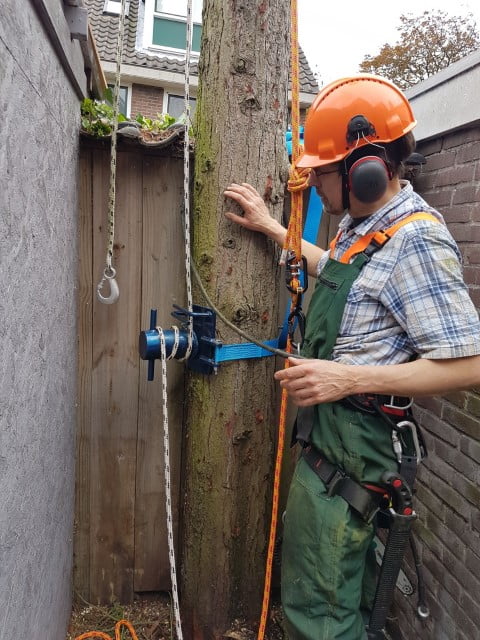
Small spot, big tree. But with our new safety bollard at the bottom of the tree, even the heaviest trunk parts can be lifted down safely.
So a tree in a "difficult" place. But that is no problem for us. By carefully hoisting the tree down in parts using modern climbing techniquess and using the right tools, it is possible to avoid damaging the roofs of the sheds. For this purpose we use, among other things, a so-called "catch bollard", which is the blue metal construction in the photo above that is attached to the tree with a tension strap. The safety bollard provides enormous friction on the safety line so that the heaviest log sections can be lowered quietly and safely to the safety line by one man. Each turn around the bollard gives the catching line extra friction, but one turn is often more than enough.
Due to pruning 25 years ago, 3 different buds had started to grow
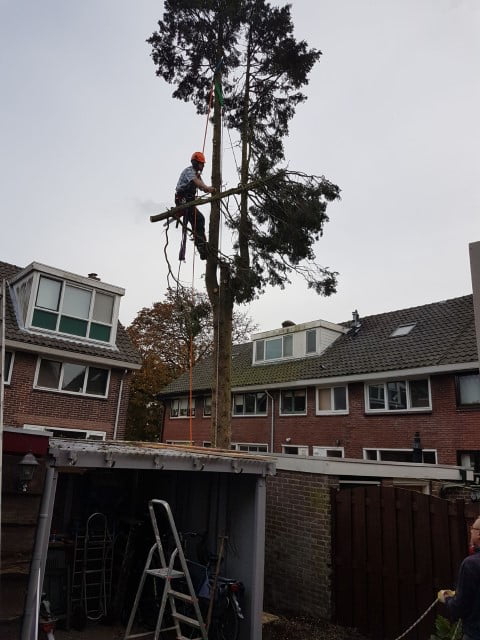
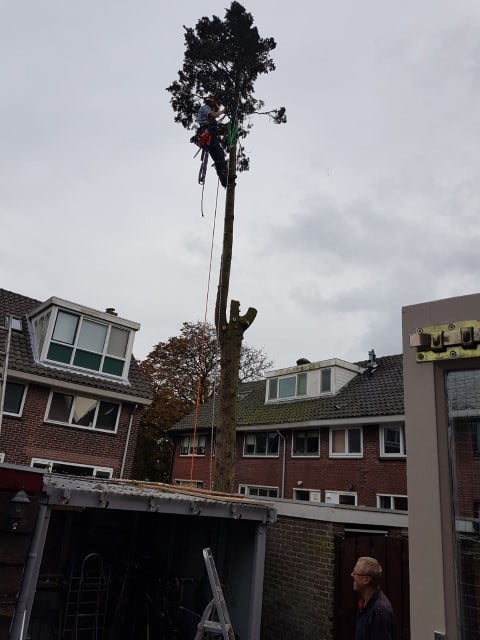
Hoist down with catch line from the two smaller tops.
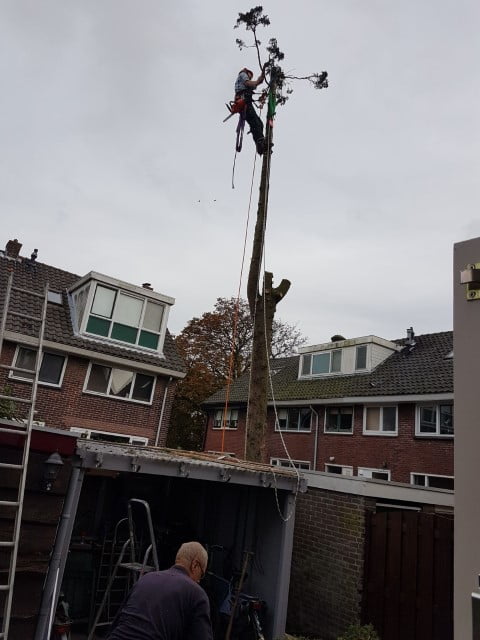
Hoisting down from the largest peak.
To start with, the side branches were lowered to the right place in the backyard using the "speedline" method. Due to an earlier "topping", 3 different tops had emerged. By climbing the thickest peak the two other peaks at the top could be attached to our take-off line. These heavy tops could still be lifted down carefully and safely via the catch bollard at the bottom of the tree.
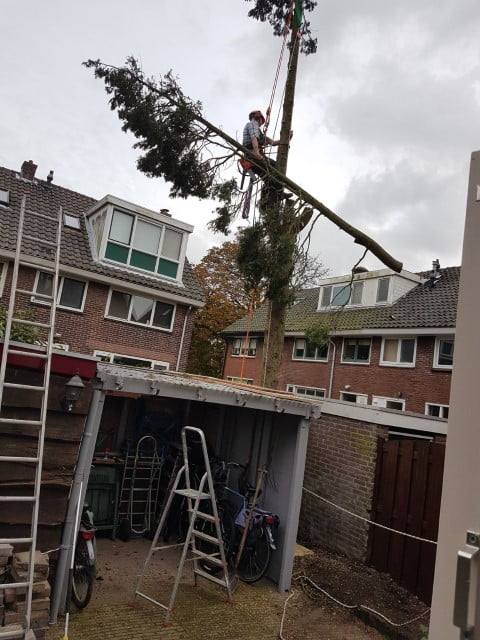
The top is off and hangs from the pulley with a catch rope to slowly lower down.
After safely hoisting down the side branches and the two smaller tops, the top is removed. This is always the most exciting moment of cutting down a tree because the wood is above the climber. You then have to carefully estimate in which direction the top will fall, because the fall notch can only provide limited guidance.
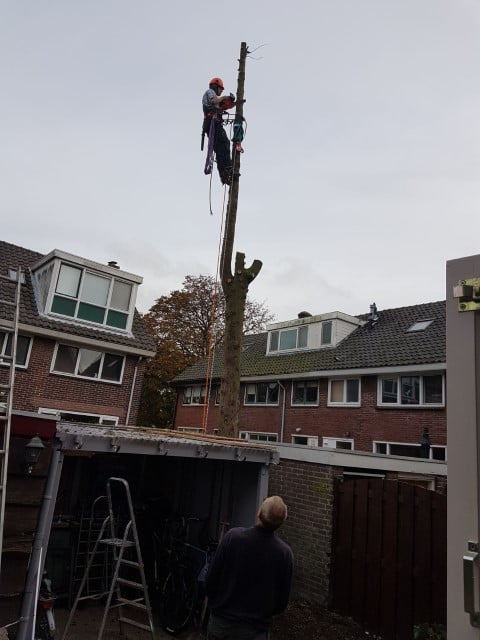
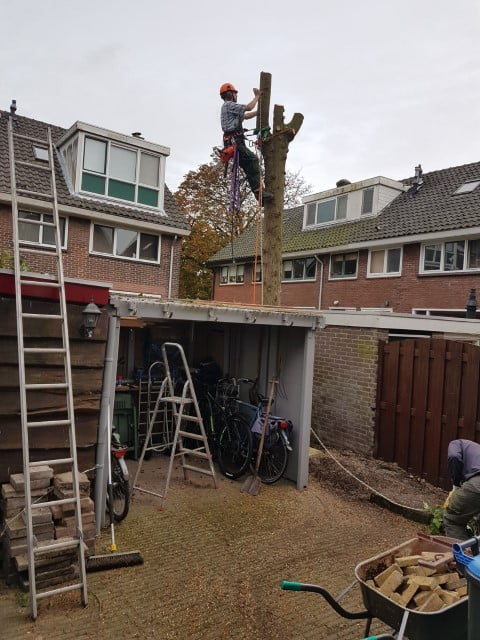
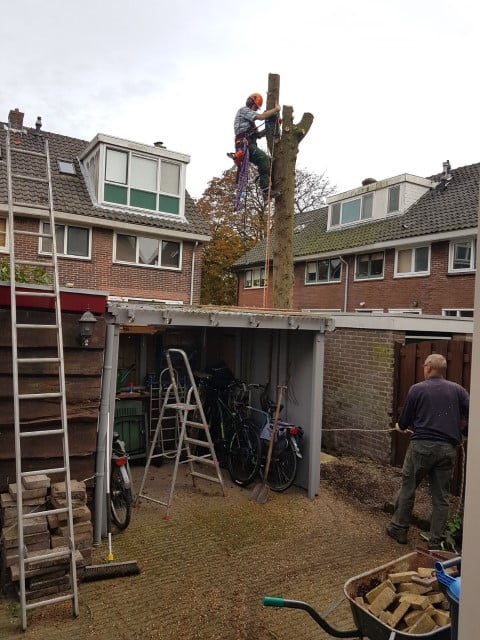
The "blocking off" of the trunk. This is hoisted down in parts.
After topping, the blocking can begin. The trunk is sawn into parts and each part is collected using the collection bollard that is attached to the bottom of the trunk. Finally, the lower trunk parts can be thrown down because they can be aimed very well. Only a small space is needed under the tree to allow them to fall safely into the right place. The stump
By excavating as much of the stump as possible, we managed to make the bottom saw cut low. Low enough that you can tile over it. The Finish
Immediately the next day, the spot of the tree was beautifully tiled by the owner. Now stones and roof tiles and some other things that previously were a bit in the way could be stored there. The Hospitality
When I was at the very top of the tree, the question arose whether I would like a sausage sandwich. It was lunch time. Normally coming back from the top and climbing back is something you want to avoid, but... with our new Petzl ZigZag (for "zigzagging" in trees), quickly climbing in and out of trees is no longer a problem. So I quickly went downstairs for a sausage sandwich. When I was spontaneously offered my own squeezed orange juice, I couldn't believe my luck anymore. How delicious that was! Thank you very much and great appreciation for the hospitality!
Photos from this project